

﷽
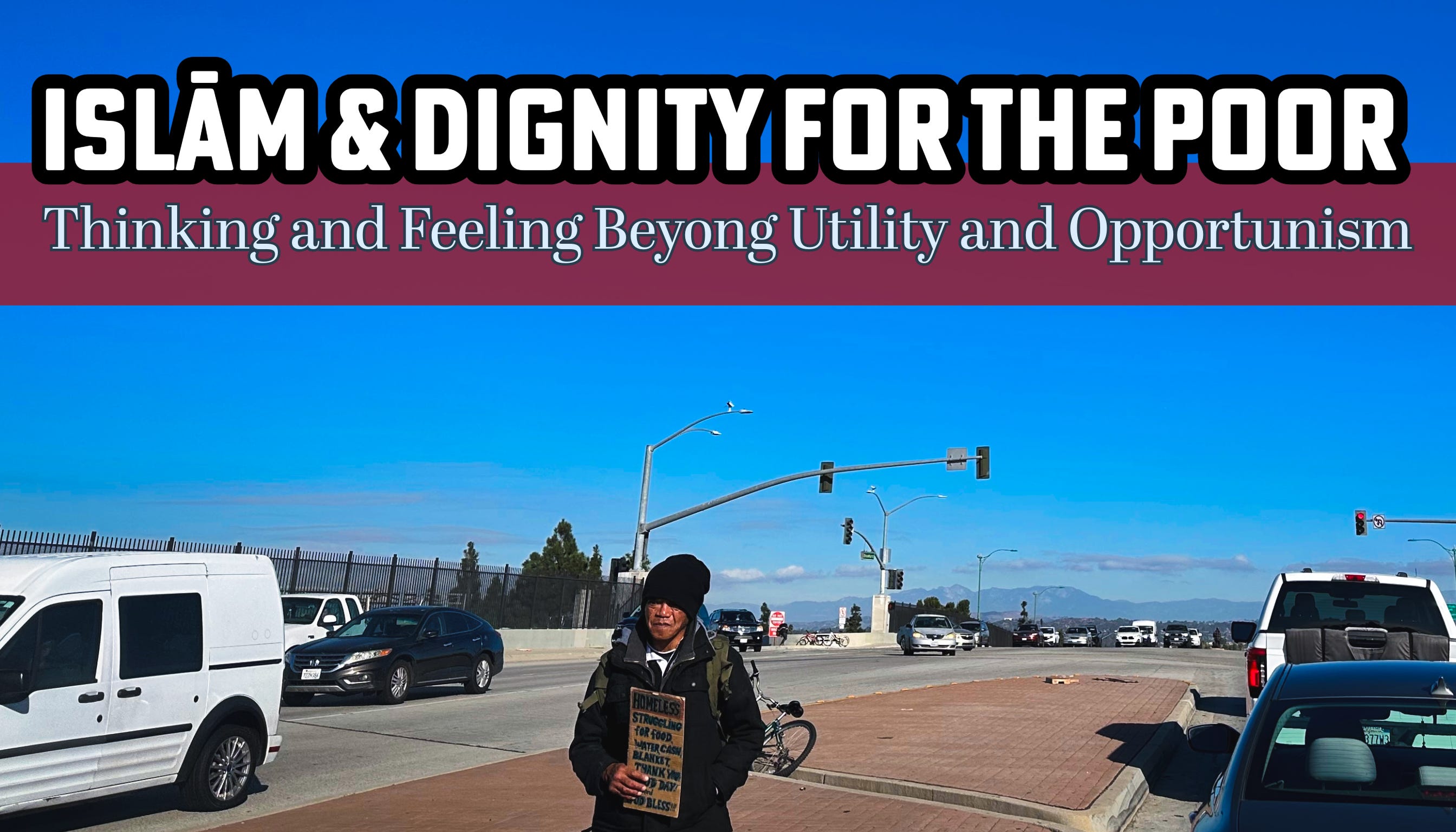
In our world today poverty is increasingly viewed through a single, reductive lens: as a problem to be solved or a charity case to be managed. This sentiment and view has extended, in my opinion, even to our Muslim community, where generosity and charitable giving are emphasized, to where I see a troubling tendency to reduce the poor to mere opportunities for spiritual gain. I don’t think this is done intentionally by any means; our community is one of tremendous charity. And yet, I can’t help feel that we’ve fallen into the modern trap of hyper utilitarianism. And so while the Qur’ān obligates charity, it does something far deeper and more profound: it dignifies the poor. It does not merely talks to the poor, it engages with them. And in doing so, it offers a radical corrective to how we think about poverty, dignity, and human worth.
Care of the poor has become somewhat crestfallen in the West. This has lead to a well-meaning yet ultimately dehumanizing attitudes toward poverty where the poor are treated as instruments for our own moral betterment. This is especially true in religious communities and ours being no different. Their suffering has become a stage on which we perform piety. As a result, the poor are seen, not as full human beings with interior lives and spiritual agency, but as passive recipients of our zakāh, as mere spiritual stepping stones on our path to paradise.
This attitude, while often unintended, distorts the very role of charity in our lives as Muslims, rich and poor alike. It also risks reinforcing hierarchies and social stratification of power and worth that the Qur’ān openly and repeatedly critiques. In Sūrah al-An‘ām (6:52), Allah directly addresses this tendency:
وَلَا تَطْرُدِ ٱلَّذِينَ يَدْعُونَ رَبَّهُم بِٱلْغَدَوٰةِ وَٱلْعَشِىِّ يُرِيدُونَ وَجْهَهُۥ ۖ مَا عَلَيْكَ مِنْ حِسَابِهِم مِّن شَىْءٍۢ وَمَا مِنْ حِسَابِكَ عَلَيْهِم مِّن شَىْءٍۢ فَتَطْرُدَهُمْ فَتَكُونَ مِنَ ٱلظَّـٰلِمِينَ
“Do not dismiss those poor believers who call upon their Lord, morning and evening, seeking His countenance. You are not accountable for their circumstances whatsoever, nor are they accountable for you. So do not dismiss them or you will be one of the wrongdoers.”
This āyah (verse) was revealed, first, directly as a command to the Prophet ﷺ, and second, in response to elites of Quraysh who demanded that the Prophet Muhammad ﷺ exclude the poor believers from his company in order to gain their favor and allegiance. The Qur’ān commands the Prophet ﷺ to refuse this transactionalism. In a radical turn, the Qur’ān actually honors the poor believers (by way of mentioning them) and extols their piety, honoring the very people their society has marginalized.
Speaking With, Not Just To
One of the many notable and extraordinary characterstic of the Qur’ān is the manner in which it engages its audience. The Qur’ān wields a style of discourse in which it speaks with its audience not just merely to them. In the case of the poor, Allāh speaks with those of lesser material means, not simple at them. It acknowledges their suffering, extols their sincerity, and praises their devotion. It commands the Prophet ﷺ to honor them not with pity, but with the greeting of paradise (Qur’ān 6: 54):
وَإِذَا جَآءَكَ ٱلَّذِينَ يُؤْمِنُونَ بِـَٔايَـٰتِنَا فَقُلْ سَلَـٰمٌ عَلَيْكُمْ
“When the believers in Our revelations come to you, say, ‘Peace be upon you’.”
This acknowledgement is not a superficial act of kindness. Nor is it merely a transaction that benefits those who give to “score brownie points”. Greater than all this, it is an actual foreshadowing of the eternal reward for those pious worshippers who happen to be materially poor. It is a divine acknowledgment, not of their poverty, but of their proximity and closeness to Allāh.
In our modern moment and culture, one where those are less materially well-off are scoffed at and those who are in possessino of material wealth are deemed to be noble, not for their character or achievements, but by way of their wealth. This decadent model is challenged by the qrn, compelling and commanding us to do more than provide aid. It calls us to listen, honor, and genuinely engage those who have less. The poor are not to be background figures in our grand, personal narratives of virtue. They are central characters in Allāh’s creation.
Devotion Over Status
What earns the praise of those poor believers in Sūrah al-Anʿām is not their destitution, but their devotion. Before formal rituals like the five daily prayers were mandated, these believers were already calling on Allāh day and night. According some some scholars, such as Ibn Juzayy, say this yadʿūna rabbahum bi al-ghadāti wa al-ʿashiyy was the daily prayer of those pious Muslims in Makkah—a difficult place at that time to do so—before it was mandated on the rest of the Muslim ‘Ummah. Their sincerity (ikhlāṣ) is highlighted as a sign of their pure hearts and nearness to Allāh.
In other words, these were not poor believers but were believers who happened to be poor. Indeed, they were spiritually rich, a richness that was not transactional; it was relational. Their value was not in how they allowed others to give, but in how they themselves gave their hearts to Allāh.
But all this praise and character didn’t come without the resentment of the wealthy and the elites, something the Qur’ān, again by way of its narrative, exposes. The elite of Quraysh could not bear to the thought of having to actually associate and mix with the poor let alone them being religiously favored. In verse 6:53, Allāh says:
وَكَذَٰلِكَ فَتَنَّا بَعْضَهُم بِبَعْضٍۢ لِّيَقُولُوٓا۟ أَهَـٰٓؤُلَآءِ مَنَّ ٱللَّهُ عَلَيْهِم مِّنۢ بَيْنِنَآ ۗ أَلَيْسَ ٱللَّهُ بِأَعْلَمَ بِٱلشَّـٰكِرِينَ
“In this way We have tested some by means of others, so those kuffar amongst the Quraysh may exclaim indignantly, ‘Has Allāh favored these poor believers out of all of us nobles?’ Does Allāh not best recognize whom the grateful truly are?
The test that the Qur’ān speaks of is that tendency of people to associate material wealth with character and worth. In this way the Quraysh were no different that our society today which places and almost transcendent value on wealth, its acquisition and its outward expression. The Qur’ān reminds them—and us—that wealth is a gift, not a badge of superiority. It is also a test, to see if we will be grateful and is not to be translated into a right for social dominance and human worth.
Beyond the Charity Model
And so there is a risk, even to the well-intended, to recast charity in such a light as to eclipse the dignity of the poor themselves, reducing them to vehicles for our good deeds. Instead, the Qur’ān resists this moral economics. It reasserts that the poor are fully human, fully dignified, and are a worth part of the ‘Ummah. Their existence is not to justify our generosity or assuage our gilt. Their pain is not a public service project. They are servants of Allāh whose dignity exists regardless of whether they receive charity or not. A beautiful example of this is the way in which the Qur’ān commands the Prophet ﷺ to extend to them the Greetings of Paradise, meaning their presence is honored, not just merely tolerated or managed.
Re-Centering the Nobility of the Children of Adam
In this moment of artificial intelligence and its ascendancy as well as the looming singularity of merging man and machine, a moment in which humans are increasingly seen as a problem to, if not just manage, but outright get rid of, it is heartening to read the Qur’ānic discourse on the poor, a language a grammar often pregnant with theological significance. The Qur’ānic discourse reminds us that we ought not say, or think of people as “poor people” but instead as “people who happen to be poor.” We have a tendency, especially in English, to put the adjective first, as if poverty circumscribes the very limits of their human and godly potential vs being a mere describes of their condition.
Towards Building a Community of Dignity
So let’s ask ourselves, “what kind of community are we building if the poor are always on the receiving end of instruction but never of real engagement?” If we insist, even unwittingly, on situating their worth in their circumstances, and those circumstances conveniently allow us to feel relieved of guilt and acquire good deeds, then are we not developing a dysfunctional system with those who are materially less privileged? I believe the Qur’ān offers us something better: it gives us a vision of a community where dignity is not measured by wealth, where taqwā is not tied to social class, and wealth is not perceived as a sign of Allāh’s pleasure.
Let us then remember and remind those who in tight circumstances that they needn’t wait for charity in order to be virtuous or possessed of human dignity.
You can also watch the video, an excerpt from my Saturday Qur’ān class, Understanding the Qur’ān, on YouTube:


